
Types of cocoa. Grains: Criollo, Trinitario and Forastero.

Featured products Learn more about our offer
View products
Many people who enjoy the benefits of cocoa don't realize that there are many different varieties of this remarkable product. Even lovers of ground cocoa beans only know that traditional raw cocoa and ground cocoa are available for sale - and that's usually where their orientation on the subject ends. Meanwhile, there are three varieties of cocoa, each of which has many more varieties that differ in composition, aroma and flavor.
According to „World Cocoa” the differences between species of cocoa can be felt even in cocoa from different growing regions. The nobler and better-selected the crop, the higher its price 1, although the process of processing the beans - that is, fermentation, drying and eventual roasting - also has a huge impact on the final flavor of the cocoa. Nevertheless, it is traditionally considered that Criollo is the noblest variety of cacao, while Forastero is the most common. Is this opinion justified? We will check it in this article!
Let's start with cocoa
Starting from the very beginning, it is necessary first to introduce our main protagonist, which is the cocoa tree: an undersized tree of the Malvaceae family, whose most famous representative is the cacao tree proper (Theobroma cacao L.) - it is this tree that dominates cocoa cultivation in most regions of the world. Closely related to the Theobroma tree is the Herrania species, the fruit of which can also be used to produce good quality cocoa. Both trees are also divided into many varieties, such as: theobroma bicolor and Herrania umbratica, which grows only in Colombia.
The flowers of the cacao tree proper resemble orchids and grow directly from the tree trunk. Cocoa does not like strong sun, so it feels best in shade, such as banana trees or other trees that provide cover from the sun. Nevertheless, artificial varieties of cacao have been developed that also do well in places with strong sunlight. An example is Ecuador's cacao CCN-51 (Colección Castro Naranjal 51), invented by independent researcher Homero Castro in the 1960s.

Theobroma Cacao fruit?
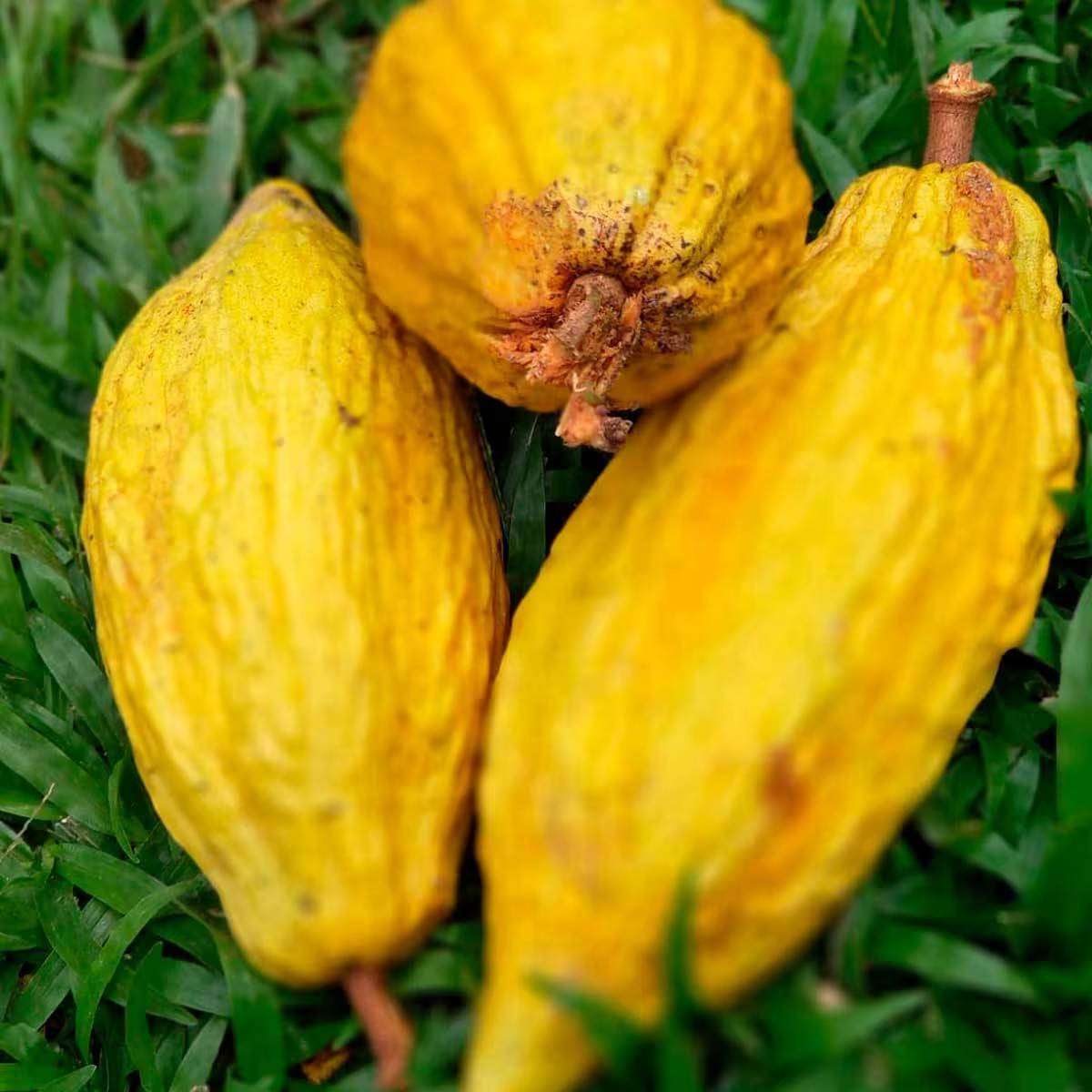
Mature cocoa fruits (Theobroma Cacao L.) can range in color from yellow through greenish to yellow-red, truly red and reddish-brown. From their shape they resemble American footballs. They reach an average length of 25 cm and have a thick shell. Inside is white, sweet flesh and within it are 25 to 50 seeds arranged in five rows. Each seed, usually covered with whitish mucus, is about 2-3 cm long.
The three main types of cocoa, namely Criollo, Forastero and Trinitario
Traditionally, cacao has been divided into three grades - Criollo, Forastero and Trinitario. This classification was established in the 1940s 2, but the names of two of the three species were given to them centuries ago by the Spanish. When we ask a person from Mexico what the word Criollo means to them, they will probably answer that it is a “mixture” or “hybrid.” Nevertheless, the word “criollo” originally meant people born in South America whose parents came from North America or Europe. Apparently, criollo cacao was the first variety the Spaniards encountered, and for this reason you may come across a translation of the word as “native.” All the rest of the cacao, on the other hand, was called Forastero, meaning “foreign.” The case with Trinitario is much simpler because we are talking about a cross between Criollo and Forastero, bred on Trinidad - hence the name of this variety. Cocoa, however, doesn't give a damn about our official classifications and happily crosses with each other - but we'll say more about that at the end of this article.

A video showing the types of cocoa
In this short video you will see the basic varieties of cocoa.
Criollo cocoa
Criollo is a noble and very rare group consisting of many varieties. It has a mere 1% share of global production, although it dominated the world until 200 years ago. It originated in Venezuela and Colombia, and is also grown today in Mexico, Colombia, Peru, Madagascar, Sri Lanka and the Caribbean region, among others. By the Mayans, Criollo cacao was considered the food of the Gods 3. Obtaining good yields of this variety is difficult, as the trees are very sensitive to unfavorable external factors. Crop yields are significantly lower than those of Forastero.
Types of Criollo Cocoa Example from Venezuela
CRIOLLO GUASARE CACAO
It is grown south of Lake Maracaibo. Currently, its plantations are quite small. It is characterized by a green fruit with a thin and slightly rough shell. It is a cacao of excellent quality.
CRIOLLO CHUAO CACAO
Perhaps the world's best-known variety, it is grown in the Chuao region of Aragua state. It is classified as “fine” cocoa.
CACAO CRIOLLO PORCELAIN
It is grown in the south of Lake Maracaibo. It has a special flavor and is classified by experts as an “extremely fine” cacao. It is considered to have the best genetic quality of all cacao grown in Venezuela.
What does the criollo cacao fruit look like?
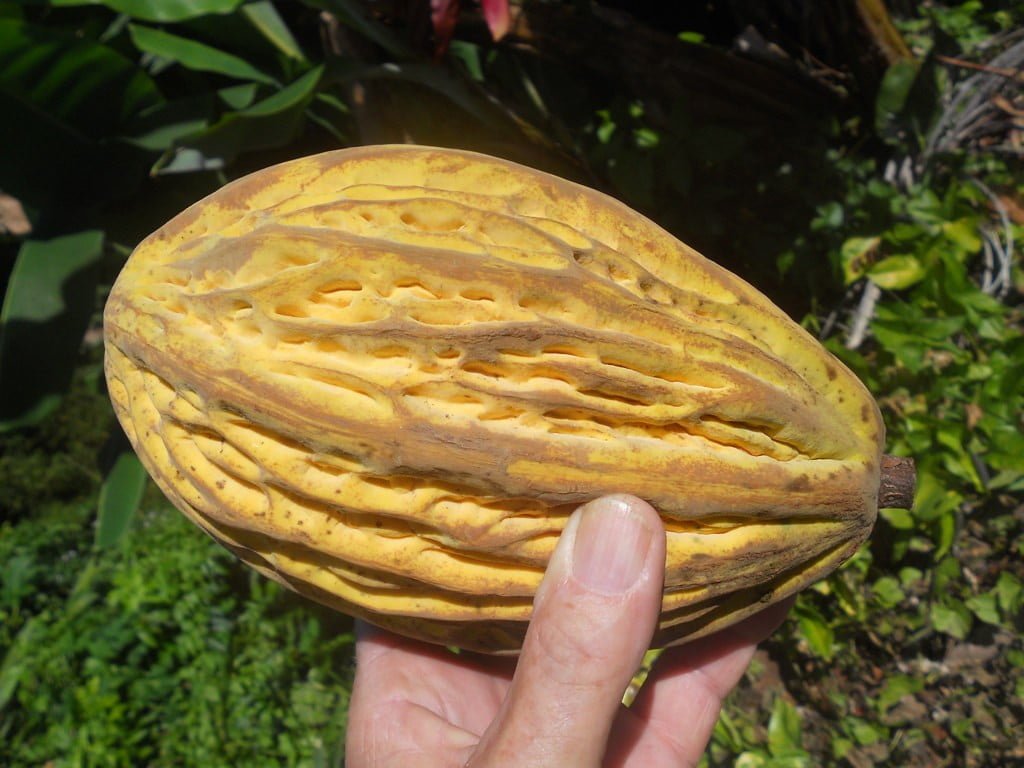
Criollo tends to have elongated fruits with rough and bony yellow skin, with clearly marked ten grooves.
What do fresh criollo beans look like?
Criollo beans are round and white or pink in the center. After being fermented and dried, they develop a complex and delicate flavor somewhat associated with caramel, nuts and vanilla. Criollo cacao is the primary ingredient used to make luxury chocolate.
Forastero cocoa
Forastero is native to the Amazon basin, which is why it is also known as “Cacao Amazonico.” It is also called “Cacao Corriente,” or “common cacao,” due to its high yields. It is now grown mainly in Africa (Ghana and Ivory Coast), although the Spanish originally imported this cacao from Venezuela. Today, Forastero dominates the global cocoa market: the variety accounts for as much as 85-95% of global production, according to various sources. It owes such a large share to its relatively low requirements and ease of cultivation (if such wording can be used for cocoa trees). It is relatively low susceptible to diseases and pests, and also grows faster and yields more than the other groups 4. There are at least several varieties belonging to the Forastero, which differ in appearance. These include, for example, the Amelonado, Cundeamor and Calabacillo varieties.
What does the forastero cacao fruit look like?
Forastero has a crackly fruit resembling a melon and a smooth skin of yellow color. The grooves on the rind are faintly visible.
What do forastero beans look like?
The grains are elliptical and purple in the center.
Trinitario Cocoa
Trinitario is a cacao with a delicate flavor. It is a hybrid of the above two varieties: Crollio and Forastero, selected in the 17th century. The trees were brought from Venezuela to Trinidad, a decision that proved to be a hit. For several decades, Trinidad produced the most coveted cocoa beans, but today Trinitario's share of the global market is less than 10%. Trinitario has the aroma of Forastero on one side and the delicate flavor of Criollo on the other.
What does the trinitario cacao fruit look like?
Trinitario has elongated, more bulbous fruit than Criollo and a slightly rough skin of yellow or red color with clearly marked, five double grooves.
What do trinitario grains look like?
The seeds are elliptical and pink or slightly purple in the center.
We are going into a forest of cocoa trees, or 1,000 varieties of cocoa.
The above traditional division into Criollo, Forastero or Trinitario turns out not to be very true, because according to the research shown in the article “Geographic and Genetic Population Differentiation of the Amazonian Chocolate Tree (Theobroma cacao L).“ 5 as many as 10 (!) varieties of cacao: Marañon, Curaray, Criollo, Iquitos, Nanay, Contamana, Amelonado, Purús, Nacional and Guiana.
Cocoa trees.
If we add cocoa that grows in Africa, Indonesia, Kerala in India or Madagascar, we find that another dozen varieties of cocoa can be distinguished. Add to this man-designed species, such as CCN-51, and it becomes momentarily clear that traditional classifications simply do not match reality.
Cocoa trees (Theobroma Cacao L. and Herrania) love to crossbreed with each other, and new varieties are being developed practically all the time. However, the taste of cocoa, or what interests us most, depends not only on the species of cocoa tree, but also on the processing. Much also depends on the quality of the machines in which the cocoa is ground and other additional factors. Therefore, the common opinion that Criollo is king and Forastero or Trinitario its less successful cousins is wrong - we can end up with very poor Criollo and outstanding Forastero, or vice versa! When reaching for different products that use cacao, it is worth experimenting and exploring new varieties to get a full picture of the rich palette of cacao flavors and aromas.
- P. Ławrowski; Jak rozróżniać ziarna kakaowca?; Świat czekolady; 5/2018; s:60-64 ↩︎
- http://sweetmatterphysicist.com/beyond-criollo-trinitario-forastero ↩︎
- https://perfectdailygrind.com/2018/08/is-criollo-chocolate-really-king-the-myth-of-the-3-cacao-varieties ↩︎
- http://www.cacaoweb.net/cacao-tree.html ↩︎
- https://journals.plos.org/plosone/article?id=10.1371/journal.pone.0003311 ↩︎